

Tech Landscape #437
An impressive image model from Meta, a new direction for ChatGPT, and a dream of Rocket League
Hello!
No intro again this week, instead I’ve written a few paras about teens’ social media use at the end.
So, let’s get on with it. Hope you’re well!

Synthetic Content
Meta launched Muse Image
The new image generation and editing model features advanced reasoning capabilities, including tool use such as browsing the Web for context and writing code, and ‘self-refinement’ for checking its own work.
ai.meta.com/blog/introducing-muse-image-muse-video-msl/
This is a really impressive model. It works in multiple steps, and reading its ‘thinking’ as it works is very interesting; in one task I saw it generate an image, critique it, decide it wasn’t good enough, then generate a completely new version to better meet the prompt. Fascinatingly, it seems that this self-refinement wasn’t a planned feature:
Muse Image reflects on and improves upon its own work within its chain of thought. This self-refining behavior can take different forms: a local edit to the current image draft when a small detail is off, a new image generation from scratch when larger parts are wrong, or a different tactic like tool use for more factually accurate generation. We didn’t design this behavior. Instead, it emerged during RL training simply because self-refinement produced better images and therefore higher reward.
It’s currently available in the Meta AI app, powers new Instagram Stories effects (in the US), and will come to Facebook, Messenger, WhatsApp, and Meta Advantage+ ads soon. It will be joined by Muse Video, but I’ll write about that when it launches.
Reve released v2.1 of its image generation model, with improved layout planning, precision region editing, multilingual text rendering, and native 4K output. blog.reve.com
ByteDance released Seedream 5.0 Pro, a ‘production-ready’ update to its multimodal image model with support for precise interactive editing, complex infographic generation, native multilingual input, and more. seed.bytedance.com
Both are also highly impressive models, Reve’s perhaps even more so as it comes from a small team rather than a giant tech company.
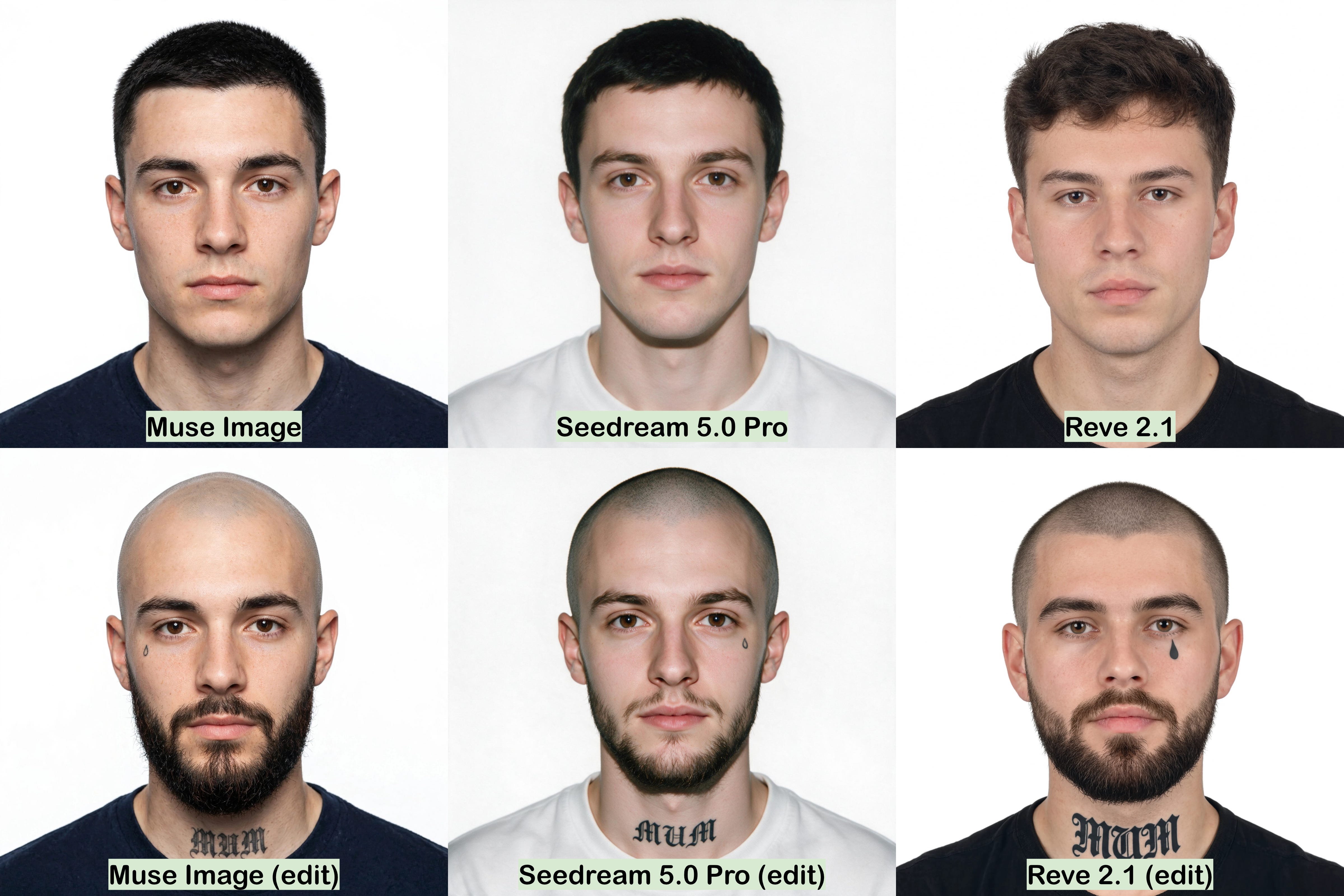
You can see how Muse Image, Seedream 5.0 Pro, and Reve 2.1 stack up in terms of image generation and editing in my test ⬇️. It’s hard to say which is ‘best’. The models at the top end of the leaderboard, such as these, have pretty much reached parity in terms of visual quality and prompt following; the difference comes down to layout control, readiness for use in professional workflows, and taste (for want of a better word).
Creative Tools
Pika Labs launched Director‘s Suite, to turn an idea into a multi-scene video by generating every step from script and storyboard to finished scenes. instagram.com/pika_labs
ImagineArt added Agent Mode for Workflows, that will build custom workflows on the fly to achieve a set creative task. threads.com/@imagineartofficial
The improvements to agentic LLMs that can handle complex workflows are showing up in creative tools. The barrier to creation is dropping even further; you can go from a simple prompt to a complex output very easily now. If the typical (simplified) process is decide → execute → deliver, the first and last steps are much more important now: having a good idea, and making the result good enough to stand out in a sea of low-effort content.
Flora added a timeline editor, enabling manual video editing as a step in a workflow. threads.com/@florafaunaai
Google Photos added Video Remix, a Gemini Omni-powered tool that uses templates, cinematic relighting, and artistic effects to transform and edit video clips. blog.google
Runway launched Runway Dev, for developers and enterprise teams to integrate first- and third-party image, video, audio, and interactive character models via a single API platform. runwayml.com
This is Runway for developers rather than consumers, enabling them to use a variety of models in complex workflows.
General Intuition’s Mira is a world model trained exclusively on multiplayer games of Rocket League, and as a result is able to generate videos that emulate multiplayer games of Rocket League; in effect a kind of a playable ‘dream’ of Rocket League.
MIRA has no physics engine, no rendering engine, and no explicit 3D representation at all. It’s just videos and actions crammed into a transformer that learns everything purely from data.
This is pretty incredible. Sure, it’s a very narrow domain at the moment, but the possibilities are very exciting. I think this will go down as a landmark in the history of world models (which are still, it should be noted, in their infancy).
Suno redesigned its web-based lyrics editor, introducing natural language editing, the Lyricist tool that will use your own lyrics as a style guide, and more, in a distraction-free full-screen writing environment. suno.com
The biggest giveaway of AI-generated music is the clunky lyrics.Mureka added Character, to create a custom synthetic singing voice based on 10 seconds of uploaded speech. instagram.com/mureka.ai
Ad Transparency
Meta will automatically label ads created or edited with AI by its own or select third-party tools that use digital watermarking. facebook.com
Google introduced AI transparency labels for ads, using a new “How this ad was made” section in the Ad Center panel on Search, YouTube, and Discover to indicate if generative AI was used to create or alter an ad. blog.google
Both of these are to meet the requirements of the EU’s AI Act, which will come into effect later this year.
Assistants & Search
Some important updates from OpenAI this week: first it launched GPT-Live, “a new generation of voice models“ that supports simultaneous listening and speaking, natural interruptions, and background task delegation. It’s rolling out to ChatGPT Voice now. Then it released the GPT-5.6 family of models, Sol, Terra, and Luna, following a limited preview period [TL 435]. Finally it introduced ChatGPT Work, a multi-step AI agent designed to execute complex projects and automate repetitive workflows across desktop and web applications.
The general consensus around GPT-5.6 Sol seems to be that it’s in the same class as Claude 5 Fable, but maybe not quite as good. IDK. The new voice model looks very interesting; the simultaneous listening and speaking leads to much more natural conversation, and those visual widgets look like a threat to Google.
ChatGPT Work enables a shift from talking to doing. There’s a new desktop app which integrates Work, Codex, and Chat in the same interface — not 100% successfully, it must be said; it feels hastily built and released, and Chat is relegated to a small sub-window. But with more consideration, this could be a much more useful assistant. OpenAI noted that the new app and expanded Chrome plugin means that the Atlas browser [TL 403] will be shut down less than a year after launch; I noted at the time that getting people to switch browsers is a very hard challenge.
Meta released Muse Spark 1.1, an upgrade to its multimodal reasoning model that’s designed for agentic tasks like coding and computer use. It’s already accessible via the Meta AI app, and in the new Meta Model API that gives developers access to use in their own apps. ai.meta.com
Although it’s only a minor version number update, it’s apparently a very large capability upgrade.
SpaceXAI launched Grok 4.5, trained specifically for coding, agentic tasks, and office work. It’s available via API, Grok Build, and Cursor. x.ai
I should remind you that I don’t have a useful method of comparing different LLMs, as I’m not a power user in any sense. But at the time of writing GPT-5.6 sits in 2nd place on Arena’s text-to-code leaderboard, Grok 4.5 in 4th, and Muse Spark 1.1 in 10th, if that’s anything to go by.
Anthropic’s Claude Cowork is coming to web and mobile, letting users run and monitor sessions across devices, with the agent prompting them for approvals on their phones. claude.com
What’s very clear from all these updates is that the days of LLMs as purely a chat interface are coming to an end; new models are aimed at taking on complex multi-step workflows for personal and professional productivity. If you’re still mostly just using an assistant as an advanced search engine, you’re almost certainly not getting the best out of it.
Manus introduced Branch, letting users start parallel chat sessions from any point in an existing conversation, inheriting all previous context without altering the original thread. manus.im
Anthropic released reflections for Claude, essentially an activity dashboard showing how you spend your time and enabling you to find (and automate) patterns in your usage. anthropic.com
XR
Samsung’s Galaxy XR headset is now available to buy in the UK, starting at £1,699. news.samsung.com/uk
I’m curious to try these, but not curious enough to spend that much money. However, something tells me they’ll be heavily discounted before long.
Social
YouTube is adding serial playlists, letting creators in the Partner Program organize their videos into structured shows, seasons and episodes. Also Gifts & Jewels are expanding to 45 more countries (including the UK), and the Gemini-powered Ask YouTube is available on desktop in the US. threads.com/@neal_mohan
Character.ai is getting into Microdramas with the release of three original shows, made in-house, where users can talk to the characters to learn more about the story. blog.character.ai
Serialised content and Micro-/Mini-dramas are really having a moment; Instagram and TikTok have both recently implemented support for it. Is this a fad, or a future of entertainment?
Google’s Search Console now includes performance tracking for social and video platforms, showing creators and publishers how their Instagram, TikTok, X, and YouTube content performs on Google Search. developers.google.com
X launched a new in-app Video Editor, with a timeline, captions, and green screen, available in the iOS app. x.com/XCreators
Teens Social Media Use
Oxford University released the preliminary findings from the BrainWaves study of more than 15,000 schoolchildren and students aged 16 to 19.
It finds that every extra hour that teenagers spend on social media is linked with worse mental health, which is a problem as more than a fifth of teenagers admit to using it for at least eight hours a day.
In terms of time spent on the platform, TikTok is the worst culprit. There’s no question about that. That’s not to say it doesn’t have other harms. But from what we’ve measured, it definitely has a big harm [effect] on anxiety and depression due to long duration abuse.
Some platforms were linked to poor mental health however much the teenagers used them; for girls this was Wizz (never heard of it), for boys, Pinterest (what?!). But Snapchat use had an inverse link to poor mental health, indicating that when platforms are used for genuine socialising rather than aimless scrolling, they may have positive effects, and even be associated with higher resilience.
This is why I think the UK’s blanket ban could be counterproductive; it’s a very blunt instrument. For example, including Snapchat in the list of banned platforms could be cutting teens off from important socialising opportunities.
As psychologist Peter Gray said:
To grow up well, children have to be able to play in the world that they’re growing up in. As a society we have almost a knee-jerk reaction to believe that the solution to any problem experienced by kids is to deprive them of yet one more freedom.
The ban also absolves platforms of their responsibilities; they should be mandated to provide tools that manage usage healthily (and appropriately). TikTok should have a one-hour limit for teens, and enforce that. Ditto YouTube. Both can be educational and useful, but also harmful when over-used.