

Tech Landscape #427
OpenAI is back in the game, vibe working comes to the workplace, and Adobe takes on agencies
Hello!
Everyone should read more history books. Right now we’re in a period of change that can feel overwhelming, and history is a way to put it all in context and make sense of it.
For example, I recently read Empires of Light, about the competition to turn electric light into a consumer product; the full transformation of leisure and work when homes and cities could suddenly have ‘daylight’ on demand.
And The Subterranean Railway, about the impact on London of the underground network, changing not only how people travelled but where they lived and worked, the enormous population boom from new towns and cities that covered what were previously fields, and even the changes in diet enabled by rapid transport of food.
What I’m saying is, the form of today’s change might be unprecedented, but change itself is a constant of the past 300 or so years, and reading history is a huge help in dealing with that.
Anyway, let’s get on with it. Hope you’re well!
Synthetic Audio-Visual
OpenAI launched ChatGPT Images 2.0
The updated image generation model has reasoning capabilities and features improved typography, greater stylistic realism, and enhanced control for complex layouts like infographics and multi-page comics, at higher resolution.
openai.com/introducing-chatgpt-images-2-0/
It’s a very impressive model, better (albeit incrementally, not exponentially) than the current champion Nano Banana Pro; take a look at the announcement page for lots of examples. You can access it now through ChatGPT and many creative aggregator tools.
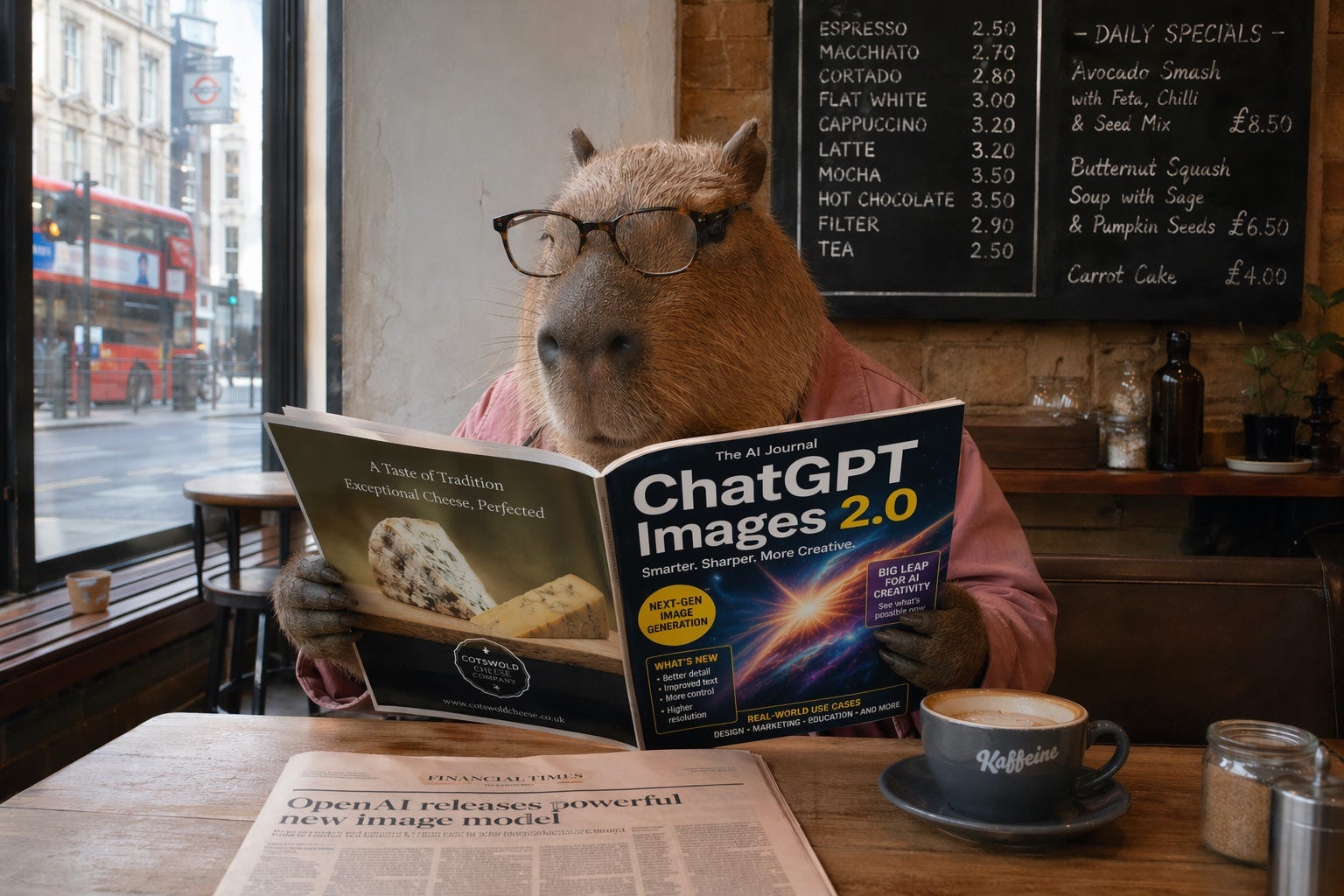
You can see in my test ⬇️ that it can handle lots of different types of text and even gets the item prices relatively right (even if £3 for a Flat White in London would be an absolute bargain). It’s especially good at complex layouts such as infographics, although to get the best out of it you’ll need the thinking mode, available to paid subscribers only.
Kling VIDEO 3.0 can now generate in 4K resolution, offering more detail and richer colours. kling.ai
It’s the first model to offer 4K natively, rather than through upscaling. View my test ⬇️ in full screen to best see the detail (hopefully it hasn’t been compressed too much).
Grok Imagine upgraded its image-to-video feature with improved lip-syncing and audio quality. x.com/imagine
I would have tried this but it appears all of Grok Imagine’s features are now paywalled with no free tier, and I’m not paying for that.Topaz released its Next-Gen update of three image optimisation and upscaling models and two video models, including Starlight Precise 2.5 which can upscale videos while running locally, without any network access. topazlabs.com/updates/next-gen
Odyssey introduced Odyssey-2 Max, an upgraded real-time world model with improvements to video realism, consistency, and physics understanding. odyssey.ml
Looks impressive, but it’s only available in private Beta to select partners; running live video generation at this quality must be very computationally expensive.
Creative Tools
Ideogram launched Custom Models, enabling the training of personalised AI image models (using 15-100 reference images) to ensure consistency in style, characters, or products. ideogram.ai
The “industry standard” for creating custom models is the LoRA technique, but this promises a different approach; however, I don’t have a Pro or Team account so I can’t judge the difference.
Google Flow added a pair of useful features: Share Link shares a link (obvs.) to any asset, with its prompt and references attached; and new video lengths of 4 or 6 seconds are available to subscribers on the Ultra tier.
Artlist launched AI Studio, a video production platform that enables creators to maintain visual consistency across shots by reusing characters and locations. artlist.io
Adobe Summit
Several new tools and features were announced at the Enterprise-focused Adobe Summit, of which these two in particular caught my eye:
Brand Intelligence validates generated assets to make sure they meet brand guidelines, instructs systems on how to stay on-brand, and soon will add synthetic audiences to simulate how content will be received. business.adobe.com
The 3D digital twin solution lets brands bring high-resolution 3D models of their physical products into Firefly ‘photoshoots’. business.adobe.com
It’s getting easier for businesses to set up and run their own marketing campaigns. I hope agencies are paying attention.
Social & Messaging
Threads launched Live Chats, spaces for real-time public group conversations during major cultural events, starting with the NBA playoffs. about.fb.com
X launched Custom Timelines, topic-based feeds curated by Grok, and is shutting down Communities but making it easier for people to join groups on XChat, which launched on iOS (I still don’t understand how the stated desire for X to be “the everything app” has somehow resulted in two apps).
Meta introduced the improved Meta Account, a centralised way to sign in across its ecosystem of apps and devices. about.fb.com
It replaces Accounts Center and lets users log in to Meta AI and Meta Quest headsets in addition to their social platforms.
Snap introduced Place Loyalty on Snap Maps, letting businesses reward users for repeat visits to physical locations with digital collectibles and special offers. newsroom.snap.com
This is a feature from Foursquare, some 15 years ago. Truly there are no new ideas under the sun.
Assistants & Search
OpenAI launched GPT-5.5, optimised for complex multi-step workflows such as coding and computer use. openai.com
Early reports (e.g from Ethan Mollick) say this is a very capable model and the first sign of a fightback to the dominance of Claude with professional users. It’s available to paid users in ChatGPT and Codex.
OpenAI’s Codex added computer use, enabling it to operate desktop apps, generate images, and use the new in-app browser, extending its utility beyond coding, and a preview of Chronicle, which uses screenshots of your recent actions to provide additional context to Codex tasks.
DeepSeek launched a preview of DeepSeek-v4, available in Flash and Pro variants, with improvements to reasoning and world knowledge and enhanced agentic capabilities. x.com/deepseek_ai
I include this largely because it’s an extremely competitive model and is open source for anyone to use (although even the Flash model is too big for use on most consumer setups). Also, remember when everyone lost their minds over DeepSeek?Yelp launched AI Assistant for improved local discovery and recommendations, and automated reservation booking. blog.yelp.com
Workplace Assistants
It seems this was a week of Enterprise announcements (see Adobe Summit, above), and while that’s largely outside of the remit of this newsletter there were a few that I want to highlight.
Google introduced Workspace Intelligence, which uses the data from Workspace apps to provide personalised responses in everything from Drive to Slides. workspace.google.com
So you can, for example, get AI Overviews in Gmail, create on-brand slides in Slides, and copy the format of existing docs into new ones in Docs. It’s like Personal Intelligence [TL 413] for businesses. It hasn’t rolled out to my company yet so I haven’t tried it.
Microsoft Copilot added agentic capabilities in Word, Excel, and PowerPoint, allowing the AI to perform multi-step, app-native actions such as formatting and data transformation. microsoft.com
They’re calling it “vibe working”.ChatGPT introduced Workspace Agents for Enterprise and Team users, using agents to perform tasks and automate workflows across connected workplace apps including Google Drive, Microsoft 365, and Slack. openai.com
What we’re seeing here is the agentic / post-OpenClaw era make its way into the hands of everyday users. It requires a change in thinking about how you use AI and software, so may take some time to make an impact, but when / if it does…
Everything Else
Fortnite creators can add AI-powered conversations to their NPCs, enabling characters with unique personalities that can remember actions in the game session, adapt their behaviour, respond in context to player input, and trigger events in-game. fortnite.com